Inside Hampton Court Palace: A Complete Guide to Every Court, Hall & Highlight
Short answer: Hampton Court is two palaces joined together. The front half is Henry VIII’s Tudor court — Base Court, Clock Court, the Great Hall and the largest surviving Tudor kitchens in the world. The back half is the Baroque palace Christopher Wren built for William III and Mary II, with the King’s and Queen’s State Apartments. Walk them in that order, allow three hours, and give the kitchens more time than you expect to.
Most palaces are one idea executed once. Hampton Court is two ideas colliding: a Tudor power statement in red brick, and a late-seventeenth-century attempt to demolish it and start again that ran out of money halfway. What survives is a building where you can cross a courtyard and change century.
How the palace is laid out
The visitor route runs roughly west to east. You enter through the Great Gatehouse into Base Court, pass through Clock Court into the Tudor heart, then continue into Wren’s apartments and out into the gardens. Six areas account for most of a visit:
- Base Court and Clock Court — the Tudor approach, 20 minutes
- Henry VIII’s Great Hall and Great Watching Chamber — 30 minutes
- The Tudor kitchens — 30–45 minutes, more on a cooking weekend
- The Chapel Royal and Haunted Gallery — 20 minutes
- The King’s and Queen’s State Apartments — 45–60 minutes
- The Cumberland Art Gallery and Georgian rooms — 20 minutes
The Tudor palace
The Great Gatehouse and Base Court
You arrive the way a Tudor guest did, under twin turrets into the largest of the courts. Base Court was lodging — dozens of guest apartments for a court that travelled with the king. Look up at the chimneys: the barley-twist brickwork is patterned differently on nearly every stack, and it is the single most recognisable thing about the building’s silhouette.
Clock Court and the astronomical clock
Through Anne Boleyn’s Gateway is the palace’s most photographed detail: the astronomical clock made for Henry VIII in 1540. It shows the hour, the month, the phase of the moon and the time of high water at London Bridge. That last dial is the tell — when your guests arrive by barge, the tide is a scheduling problem.
The Great Hall
The last medieval great hall built for an English monarch, with a carved and gilded hammerbeam roof and Flemish tapestries on the walls. The court ate here in two sittings. Henry did not: he dined in state elsewhere while several hundred household members worked through their rations below. Stand at the far end and look back — the room was designed to be entered, not surveyed.
The Tudor kitchens
The largest surviving Tudor kitchens anywhere, built to feed a court of roughly 600 people twice a day. On many weekends the roasting hearths are lit and historical cooks work period recipes, which turns a set of rooms into a working demonstration. This is consistently the section visitors say surprised them most, and consistently the one people budget too little time for.
The Chapel Royal
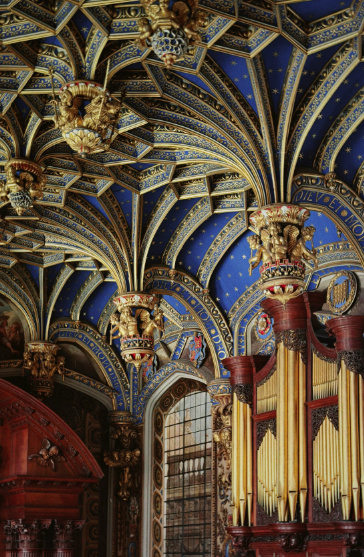
Still a working chapel after nearly five centuries, viewed from the Royal Pew above. The blue-and-gold fan-vaulted ceiling is one of the finest Tudor interiors in existence. Because it is in use, it can close at short notice for services — a live building rather than a preserved one.
The Haunted Gallery
The processional gallery linking the royal apartments to the chapel is where Catherine Howard is said to have run screaming to plead with Henry in 1541. She was executed at the Tower of London three months later, not here. The reports of an apparition, the 2003 CCTV figure the palace released itself, and the psychology study that measured cold draughts in exactly the spots visitors named are all covered on the Hampton Court ghost tours page.
Wren’s Baroque palace
Pass the colonnade and the building changes: Portland stone, tall sash windows, painted staircases, symmetry where the Tudor half had accretion. William III and Mary II hired Christopher Wren to replace the whole palace. Mary died in 1694, money ran short, and the Tudor courts survived by accident.
The King’s Apartments
These process formally from guard chamber through presence chamber to the bedchamber, and the sequence is the point — each room admitted fewer people than the last, so how far you got measured your standing at court. They were gutted by fire in 1986 and restored to their William III appearance, which is why they read so coherently today.
The Queen’s State Apartments
The eastern answer to the King’s side, finished for later Georgian monarchs, looking down the Great Fountain Garden to the Long Water. The view from these windows is the best argument in the building for doing the interiors before the gardens: you see the plan from above first, then walk it.
The Cumberland Art Gallery and the Georgian Story
The Royal Collection pictures hang here, alongside rooms telling the palace’s eighteenth-century life. Note for 2026: the Mantegna Gallery is closed until Spring 2027, with two of the Triumphs of Caesar canvases displayed in the Georgian Story meanwhile.
Reading the seam between the two palaces
The most interesting few metres in the building are where Tudor meets Baroque. Walk from Clock Court through into the Fountain Court and watch the material change under your hand: warm hand-made brick with diapered patterning gives way to cut Portland stone and regular sash windows. Tudor building is additive — a court here, a lodging range there, as need and money allowed. Wren’s is a single drawn idea imposed at once.
Knowing that changes how the rooms read. The Tudor half rewards looking up: roof timbers, badges, chimneys. Wren’s half rewards looking along: enfilades of doorways aligned so you can see through five rooms at once, which was the point — a visitor was meant to understand exactly how far in they had been allowed. The facts page has the dates behind both campaigns.
Time by area
| Area | Allow | Do not miss |
|---|---|---|
| Base Court & Clock Court | 20 min | The astronomical clock; the patterned chimneys |
| Great Hall | 20 min | The hammerbeam roof and the tapestries |
| Tudor kitchens | 30–45 min | The roasting hearth, lit on many weekends |
| Chapel Royal | 15 min | The fan-vaulted ceiling from the Royal Pew |
| King’s Apartments | 30 min | The processional sequence of rooms |
| Queen’s Apartments | 25 min | The east-front view down the Long Water |
Five things most visitors walk straight past
- The wine fountain in Base Court — a working replica of the one painted in the Field of the Cloth of Gold.
- The real tennis court — an indoor royal tennis court still in play. You may catch a game.
- Carved graffiti — centuries of residents cut their names into the stonework. Private guides love pointing these out; one traveller called it the detail she remembered most.
- The chocolate kitchen — the surviving royal chocolate-making room, a Georgian addition most people never find.
- The ceiling of the Great Watching Chamber — original Tudor, with badges of Henry’s queens worked into it.
Should you take a guide through the interiors?
The free audio guide is genuinely good and covers the main route. What it cannot do is answer a question. The private guides here are specialists — a former state apartment warder of eighteen years leads the private guided tour of Hampton Court Palace, and an architectural historian with a Hawksmoor Medal for a paper on this building leads the architectural historian's private tour. If the building itself is what interests you, that difference is the whole visit.
The route to walk if you only have two hours
Skip nothing important by going in this order: Base Court, the astronomical clock in Clock Court, the Great Hall, the Great Watching Chamber, the Tudor kitchens, then straight through to the King’s Apartments and out via the Queen’s side to the east front. That covers both palaces and every headline room, and it leaves the Cumberland Art Gallery and the Georgian rooms as the things you sacrifice.
Doing it in reverse — Wren first, Tudor second — works better on a busy afternoon, because the coach groups all start at the Tudor end. Timing advice for the whole day is in how to visit Hampton Court Palace, and the practical detail sits on the visitor information page.
For the outdoor half of the estate, continue with the gardens and Maze guide; for the chronology behind the rooms, the history page lays it out from 1514. And if you are still deciding how to see it, Hampton Court Palace Tours compares every option in one place.
Walk these rooms with a guide who knows their stories — compare private Hampton Court Palace tours.
Tickets from $43 · free cancellation on all but one option.